
|
|
|
|
Biological ControlsThe Challenge The Hope Advice How to Help on Public Lands Supporting the Beetle Labs Publications
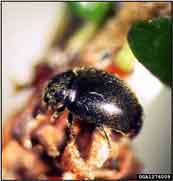
The HopeBut there is also cause for hope. The U.S. Forest Service has designated 144 Hemlock Conservation Areas in the Chattahoochee-Oconee National Forest in Georgia for treatment with biological or chemical controls or both (separated by a buffer of space and/or time). About 800,000 beetles have been released in the designated insect areas so far, and researchers have recently documented solid evidence of beetle survival and reproduction in the wild. The chemicals being used to treat hemlocks in the designated insecticide areas are proving to be quite effective, and while it is recognized that chemicals are a "band aid," they are working very well and buying valuable time in which long-term, natural solutions can be developed. Click here for a map of the Hemlock Conservation Areas in Georgia, some explanatory information on how the priorities were established, and a chart indicating the location name, treatment method(s), and number of acres for each area.
AdviceSo what does all this mean for private property owners who want to help their hemlocks? For now, property owners should continue to treat their trees with a combination of cultural and chemical controls; these are the best solutions from the standpoint of both cost and effectiveness. Beetles are not yet an advisable option for private property because of the as-yet unproven performance of the single-species approach, the unavailability of the multi-species complex, and the extreme expense.
How to Help on Public LandsTreating Hemlocks on Public Lands -- Save Georgia’s Hemlocks and the U. S. Forest Service have established an agreement under which SGH Facilitators and other volunteers can chemically treat hemlocks in designated Hemlock Conservation Areas (HCAs) of the Chattahoochee-Oconee National Forest. We have a similar agreement with the Georgia Department of Natural Resources to treat hemlocks in wildlife management areas and state parks on a project-by-project basis. Anyone interested in treating hemlocks on a public lands project may call the Hemlock Help Line 706-429-8010. Helping Hemlocks in Other Ways -- If you would like to help the hemlocks on public lands in Georgia in ways other than actually treating trees, you can volunteer with the U. S. Forest Service, the GA Forestry Commission, the Georgia Department of Natural Resources, or any of the Friends of the Parks organizations in Georgia. Then, when volunteer opportunities arise, they can contact you to see if you’re available to help. The nature of the activities will vary widely but might include measuring and tagging trees that will be or are being treated or monitoring sites that have been treated with beetles or chemicals.
Supporting the Beetle Labs
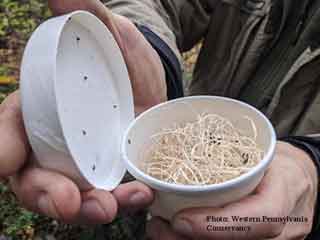
The labs are also in need of volunteers to help gather infested hemlock branches that the beetles feed on, perform other tasks in the lab, monitor beetle release sites, and possibly participate in beetle releases. If you'd like to volunteer, please contact the lab manager. Research labs rearing beetles for release in Georgia are:
Other beetle-rearing research labs in the south include the University of Tennessee at Knoxville, State of North Carolina Agriculture Department, and Virginia Tech. In the northeast, there are beetle-rearing research labs in New Jersey, Connecticut, and Massachusetts.
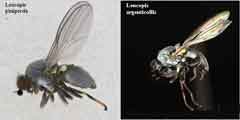
Publications Addressing Biological Controls■ Silver Flies for Control of HWA -- NEW Article prepared by Brianna Ross, 2023 ■ Developing Hemlocks Resistant to HWA -- PowerPoint presentation prepared by K. L. F. Oten, L. N. Walker-Lane, R. M. Jetton, N. Kaur, B. Smith, J. Frampton, A. C. Cohen and F. P. Hain to provide an update on the progress made to develop a HWA-resistant hybrid hemlocks. 2011. See "Development of Resistant Hybrid Hemlocks" from 2010 and "New Hemlock Hybrid Withstands Killing Insect" from 2020. ■ Development of Resistant Hybrid Hemlocks -- Research summary by Michael Montgomery, Susan Bentz, and Richard Olsen, July 2010 ■ Fungi Associated with HWA and Assessment of Entomopathogenic Isolates for Management -- This research paper by W.R. Reid, B.L. Parkerb, S.Y. Gouli, M. Skinner, V.V. Gouli, and H.B. Teillon, describes research on fungal pathogens associated with the hemlock woolly adelgid and their ability to cause mortality in low-density populations of aestivating sistens. ■ Gene Conservation of Carolina and Eastern Hemlocks -- Camcore (Department of Forestry & Environmental Resources at North Carolina State University) and the USDA Forest Service are collaborating to collect seeds from populations of both Carolina and eastern hemlock throughout the southern U.S. These seeds have been placed in cold storage or have been germinated to establish ex situ conservation plantings in Latin America and the Ozark Mountains of Arkansas. ■ New Hemlock Hybrid Withstands Killing Insect -- Exciting announcement from the USDA about "Traveler," the new hemlock hybrid that is resistant to HWA. 2020 ■ Young Harris College Hemlock Project -- article about The YHC Hemlock Project published on YHC's web site, 2010 Back to HWA Controls Cultural Practices Chemical Treatment
|
|
© Save Georgia's Hemlocks
2009-2024. |













 Please LIKE US on